Dunhuang Research Academy
Introduction
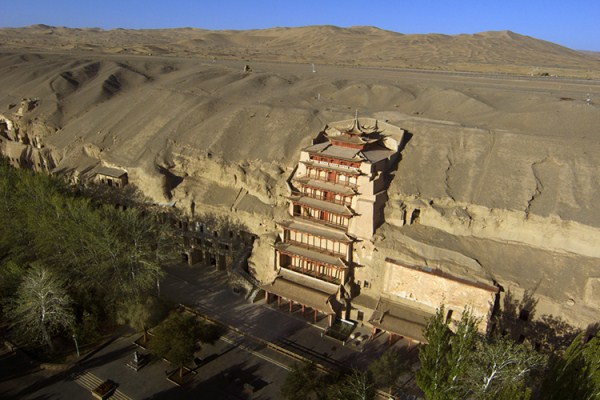
The Dunhuang Research Academy, located on the eastern slope of Mingsha Mountain in Dunhuang, Jiuquan, Gansu province, China, is a renowned institution dedicated to the preservation, research, and promotion of the Mogao Caves and other cultural heritage sites in the region. Established in 1944, originally named the National Research Institute on Dunhuang Art, the academy has played a pivotal role in safeguarding the treasures of the Mogao Grottoes, the Yulin Grottoes, and the Western Thousand-Buddha Grottoes. These sites collectively represent a significant portion of China's ancient cultural heritage, with the Mogao Caves being recognized as a UNESCO World Heritage Site since 1987.
The Mogao Caves, also known as the Caves of a Thousand Buddhas, were first established in 366 AD by a monk named Lezun. Inspired by the spiritual vision of Buddha Light on the Echoing Sand Mountain, Lezun began carving the first cave. Over the centuries, thousands of people contributed to the creation of these caves, resulting in a remarkable collection of 735 caves, 492 of which contain artwork. The caves house 45,000 square meters of murals and 2,415 stucco statues, showcasing the rich cultural and artistic achievements of ancient China.
The Dunhuang Research Academy is responsible for the day-to-day management of these sites, as well as their preservation and research. Visitors to the Mogao Caves are introduced to the site through the Mogao Cave Digital Center, which provides introductory films and guided tours led by the academy's docents. These tours typically cover 10 caves, offering insights into the history, art, and cultural significance of the site.
Research and Contributions
Academic Studies
The Dunhuang Research Academy has made significant contributions to the study of the Mogao Caves and the broader cultural heritage of Dunhuang. The cave art and manuscripts discovered in the Library Cave provide invaluable resources for understanding the religion, history, geography, politics, economics, art, literature, technology, folk customs, costumes, and astronomy of China and Central Asia. The Library Cave alone yielded over 50,000 manuscripts, written between the 4th and 11th centuries, in a variety of languages including Chinese, Tibetan, Sanskrit, Uighur, Sogdian, and others. These manuscripts are considered an "encyclopedia of the medieval period" due to their detailed documentation of social conditions.
The academy has also established research laboratories to simulate environmental conditions surrounding historical sites and relics. These facilities, supported by a significant investment of 40 million yuan, enable researchers to study the weathering of rocks, the mechanisms of salt damage on murals, and other factors contributing to the deterioration of cultural relics. This research has shifted the focus of heritage conservation from reactive rescue efforts to proactive prevention of deterioration.
International Collaboration
The Dunhuang Research Academy has actively engaged in international collaboration to promote the cultural heritage of Dunhuang. In recent years, the academy has partnered with global organizations and technology companies to digitize and share the treasures of the Mogao Grottoes. In 2006, the academy launched a digitization project to create a high-definition database of the statues and murals. By 2016, the academy had completed the digitization of over 100 caves and launched e-dunhuang.com, a website offering virtual views of 28 Mogao Caves.
In December 2023, the academy signed agreements with Tencent, a leading Chinese technology company, to develop virtual-reality and augmented-reality channels for displaying cultural relics. This collaboration aims to create a new digital-display platform, allowing people worldwide to experience the cultural splendors of Dunhuang. Tencent has also developed Dunhuang-inspired content for online entertainment products, including games, cartoons, and music, to attract younger audiences and promote the history and culture of Dunhuang.
Cultural Promotion Abroad
The Dunhuang Research Academy has been instrumental in promoting the cultural heritage of Dunhuang on the international stage. Through exhibitions, concerts, and multimedia presentations, the academy has brought the art and history of the Mogao Grottoes to audiences worldwide. For example, exhibitions featuring replicas of the Mogao Grottoes have been held in cities such as Shenzhen, Shanghai, and Venice, showcasing the exquisite murals and sculptures to new audiences. These exhibitions often incorporate cutting-edge technology, such as virtual reality and holographic imaging, to provide immersive experiences.
The academy has also collaborated with QQ Music on the "Jüe" project, which focuses on the preservation and revival of ancient Dunhuang music. Concerts featuring authentic Dunhuang music and modern adaptations have been broadcast live to millions of online viewers, further expanding the reach of Dunhuang's cultural legacy.
Through these efforts, the Dunhuang Research Academy continues to fulfill its mission of preserving and sharing the treasures of Dunhuang with the world, ensuring that this unique cultural heritage remains a source of inspiration for future generations.








